The moment someone figured out how to strip the lead vocal off a recorded song, everything changed for singers everywhere. What used to require an entire live orchestra suddenly became something anyone could do. You just needed a decent voice and a bit of courage. That single technical breakthrough, deleting the original voice from a track, is the quiet revolution behind karaoke. It's still shaping how people discover, perform, and fall in love with music today.
Karaoke is a Japanese term for a performance in which a person sings along to recorded music. The word itself is a blend. It comes from a shortened version of "karappo," meaning "empty," combined with a clipped form of "okesutura," the Japanese pronunciation of "orchestra." Put the two together and you get "empty orchestra." In plainer English, that means "music without the lead melody." That's a pretty accurate description of what karaoke still is at its core, decades later.
The technology has obviously moved on. What started as a novelty became a global phenomenon. It eventually paved the way for the modern online backing track service, where singers can order professionally produced instrumentals built specifically around their voice, key, and style.
Daisuke Inoue, a Japanese inventor and musician, built the world's first karaoke machine, the Juke-8, in 1971. Interestingly, Inoue never patented his invention. That meant he never profited from what became a billion-dollar industry. That legal distinction actually belongs to Filipino inventor Roberto del Rosario, who developed and patented the Karaoke Sing-Along System in 1975.
It's a strange footnote in music history. The man who arguably invented karaoke walked away with nothing, while the man who filed the paperwork got the credit on paper. But regardless of who owns the patent, both innovations kicked off a shift in how ordinary people related to music, moving them from passive listeners to active performers.
To understand why karaoke was such a big deal, it helps to look at what came before it.
Traditionally, film music was performed, or rather recreated, on stage for public audiences with the help of a full live orchestra. These orchestras were genuinely massive undertakings. A typical lineup included brass, percussion, woodwind, string, and rhythm sections. Musicians often played the saxophone, trumpet, clarinet, tabla, dholak, bongos, conga, drums, octapad, cymbals, flute, harmonica, accordion, harmonium, banjo, violin, mandolin, cello, guitar (acoustic, electric, Spanish, and Hawaiian variants), piano, and keyboard. Music directors also used whatever other gadgets they could find for special effects.
If you grew up around live orchestras in India, certain names probably still bring back memories. Think of light music orchestras like A.V. Ramanan's Musiano, Sridhar's Navraags from the 1980s, and Balaji's Mazhalai Pattalam. More recent acts like Lakshman-Sruthi, UK Murali, and Mouna Ragam Murali carried this tradition forward in Chennai. Anyone who spent their school years in Mumbai probably remembers Babla and his orchestra too. Their live shows were legendary in their day.
But here's the catch: singing with a live orchestra wasn't something just anyone could walk into. It demanded serious skill, planning, and rehearsal. This became a genuine barrier for talented, ambitious people who simply didn't have a platform. To get on that stage, you needed a voice that closely resembled the original singer's. You also needed the discipline to actually pull off a live performance in sync with a full band. Talent alone wasn't enough. You needed access, training, and often a fair bit of luck.
Before it was even called "karaoke," this practice went by a much simpler name: Sing-Along. That's really all it was in its earliest form, a way to sing over music that already existed, without the pressure of an actual band watching your every move.
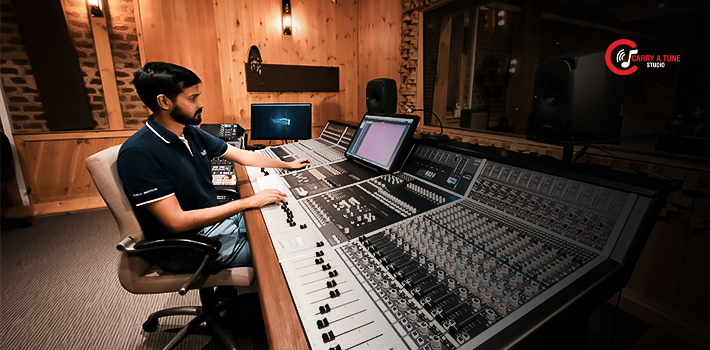
The real turning point came with the advent of multi-track recording technology combined with the introduction of karaoke systems. For the first time, it became genuinely possible to delete the vocal track from a recorded song and keep everything else intact. The drums, the bass, the strings, and the melody line all stayed exactly where they were. Only the voice was missing.
This is the moment the stage opened up for everyday singers who had passion but not necessarily professional training or orchestra access. Suddenly, you didn't need an orchestra behind you. You just needed the instrumental version of the song and the nerve to sing into a mic.
In professional music circles, a soundtrack that has all the background music (BGM) intact but the voice removed is known as a minus one track. Today, most people simply call these Karaoke Tracks. They come in two forms: audio-only and video.
Video karaoke tracks tend to be more beginner-friendly. They display lyrics and visual cues on screen, helping singers stay on beat and on pitch even if they've never heard the song a hundred times. Audio-only karaoke is tougher. It demands a much deeper familiarity with the song's structure, timing, and subtle instrumental cues, since the singer has to recreate all of that from memory and instinct rather than following a prompt.
With today's open-source tools and free software, singers can also adjust the pitch and tempo of a track to better match their own vocal range. This flexibility is part of what makes a good custom karaoke track so valuable. It's not just a generic instrumental pulled off YouTube. It's shaped around the exact needs of the person singing it.
Beyond software, there are now entire studios and online platforms built specifically around helping singers record and perform. Portals like Smule and Star Singer have become genuinely popular. They give amateur and semi-professional singers a low-pressure space to practice, record, and share their performances.
There are also countless YouTube channels run by individuals who upload free karaoke tracks, mostly video versions, as a service to the singing community. Some of these are impressively well-produced. Their instrumental replication is so close to the original that performing over them feels almost indistinguishable from singing with the actual band. Singing along to high-quality, high-fidelity tracks like these is a genuinely rewarding experience. That's a big reason karaoke has held its appeal for so long.
That said, free tracks aren't always reliable. Pitch can be off, timing can drift, and instrumentation is sometimes muddled or incomplete. This is exactly why more serious singers, including wedding performers, cover artists, YouTubers building a channel, and anyone prepping for a stage show, increasingly turn to a proper online backing track service instead of relying on whatever they can scrape together for free. A dedicated online backing track service can deliver a clean, studio-quality custom karaoke track tailored to the singer's key, tempo, and instrumentation preferences, without the guesswork of free downloads. If you're ready to skip the guesswork entirely, you can order a custom karaoke track from Carry A Tune and get a professionally produced instrumental built around your voice.
Thanks to the free (and paid) availability of karaoke tracks, thousands of people have stepped out of their bathrooms and bedrooms and onto real stages. What used to be a private, shower-singing hobby has become a legitimate form of public performance. Groups and individuals now regularly organize karaoke-based events, both privately and publicly. These events have become a genuinely cost-effective way to put on a show, since all you really need is basic audio equipment, which can be rented affordably almost anywhere.
This shift matters more than it might seem at first glance. Karaoke essentially removed the gatekeeping that used to surround live musical performance. You no longer need to convince a bandleader you're good enough. You don't need to memorize charts or rehearse with a dozen other musicians. You need a track and a mic. That's the entire barrier to entry now, and it's a big part of why karaoke culture has exploded across bars, restaurants, house parties, and online platforms alike.
As karaoke has matured from a novelty into a legitimate creative outlet, the demand for high-quality instrumentals has grown right alongside it. Serious singers, the ones recording covers for YouTube, performing at weddings, or building a following on social media, have realized something important. A mediocre backing track can undercut even a great vocal performance. Pitchy instrumentals, missing sections, or poorly mixed audio distract from the singer rather than supporting them.
That's the gap a professional online backing track service is built to fill. Instead of hunting through YouTube for a track that's "close enough," singers can commission a custom karaoke track built specifically to their key, tempo, and vocal style. It gets recorded and mixed by people who actually understand music production. That's the difference between borrowing someone else's version of a song and having one made just for you. For singers who want that level of quality, an established online backing track service like Carry A Tune's backing tracks page is worth exploring before your next performance.
Karaoke started as a simple technical trick: removing the lead vocal from a recorded song. It ended up reshaping who gets to perform music and how. What once required a live orchestra, formal training, and a voice that closely matched the original singer has now become accessible to anyone with a mic and the will to sing. From Daisuke Inoue's original Juke-8 machine in 1971, to Roberto del Rosario's patented Sing-Along System in 1975, and all the way through to today's on-demand custom karaoke tracks and online backing track services, the technology has kept evolving. The core idea has stayed exactly the same: strip away the original voice, and let someone else's story shine through the melody.
Free karaoke tracks and YouTube covers will always have their place for casual singing and practice. But for anyone taking their performance seriously, including cover artists, wedding singers, content creators, and aspiring professionals, investing in a proper custom karaoke track through a reliable online backing track service makes a real difference. It means better pitch accuracy, cleaner mixing, and an instrumental built around your voice instead of someone else's.
Whether you're belting out a classic at a friend's birthday party or building a serious singing career one cover song at a time, the tools available today make it easier than ever to sound your best. Ready to get your own professionally made track? Explore custom karaoke tracks at Carry A Tune and start singing your way.
mnagar@gmail.co.in
I have been using karaoke music for practice. Karaoke makes my practice quite exciting and enthusiastic.
The music industry has changed more in the last 25 years than it did in the previous century. What once required access to expensive recording studios, major record labels, and industry connections can now be achieved with a laptop, an internet connection, and the right creative team. Today, artists can collaborate with a song composer online, hire producers from different countries, and complete entire projects through remote music services wit [...]
When Music Stopped Chasing Virality By 2026, the music industry reached an inflection point. After years of chasing algorithms, viral moments, and rapid experimentation, creators and audiences began valuing something deeper: intentional sound, cultural clarity, and emotional truth. The modern song maker was no longer driven by trends alone, but by a desire to create work rooted in identity and meaning. The shifts shaping music toda [...]
The Indian music scene has always thrived on diversity, from classical ragas to hip-hop beats. As we step into 2026, this evolution continues to accelerate, with emerging genres and hybrid sounds dominating digital platforms. If you observe how listener preferences are transforming, the top 10 genres in the indian music industry provide a clear snapshot of this expanding sonic landscape and shifting audience behavior. From AI-driven [...]
The global music industry has undergone a massive transformation in the last decade. The rise of digital tools, virtual studios, and cloud-based platforms has turned laptops into creative powerhouses. Artists no longer need to rely solely on physical studios; instead, they can collaborate with professionals across continents with just a few clicks. This digital revolution has given rise to online mixing engineers, experts who refine, balance, an [...]
Understanding the Key Elements Behind Successful Beat Sales Selling beats has become a viable revenue stream for producers worldwide in today’s digital music economy. Platforms like BeatStars, Airbit, and YouTube have empowered producers to market and monetize their creations independently. However, with tens of thousands of beats uploaded daily, the market is saturated, and only a select few manage to stand out and generate consistent sales. So [...]
Monetizing music today is no longer limited to record deals and live performances. With the rise of streaming platforms, digital tools, and global connectivity, independent artists now have more opportunities than ever to earn a sustainable income directly from their craft. However, while the barriers to entry have lowered, standing out and generating consistent revenue still requires a well-rounded, strategic approach. Successful musicians toda [...]
Imagine a world where your music isn’t limited by the size of a record label or the constraints of traditional media. In 2025, that world is here and it’s yours for the taking. Independent artists are no longer just fighting for a seat at the table; they’re building their own stages, creating their own fanbases, and shaping their careers on their own terms. The digital revolution has opened the floodgates to endless opportunities, from online mu [...]
Starting a music career can be one of the most fulfilling yet unpredictable paths. The music industry has endless possibilities but is also highly competitive and constantly evolving. Whether you're a seasoned performer or just starting to make your mark, the journey requires more than raw talent. It takes hard work, strategic thinking, networking, and personal growth. If you’re serious about making a career in music, there are fundamental [...]
The digital revolution has transformed the way we interact with music. No longer confined to physical venues or personal playlists, music now thrives in online communities, spaces where creativity, collaboration, and connection converge. These communities have reshaped how music is created, discovered, and enjoyed and fostered a global cultural exchange that continues to grow. This blog delves deep into the multifaceted power of online mu [...]
The music video production industry has seen significant evolution over the decades, with each era bringing new trends, technologies, and shifts in how we consume and engage with music. The current landscape, shaped largely by the pandemic, has accelerated certain trends and forced both established and independent artists to adapt in innovative ways. Here’s a look at some key developments and trends shaping the music industry today: The Rise of [...]
The uniqueness of every music genre in India brings us together. We all know the unique style of Indian Music, which has billions of fans worldwide, both inside and outside India. But did you know that the influence of Indian Music on Western Music is as old as the Beatles? Today's article briefly introduces the types of Indian Music that vary by era, genre, and region. So, let's dive in without any further effort! Indian Classical Music [...]
India's best music arrangers and programmers include Ranjit Barot, Aditya Dev, Kalyan Baruah, Clinton Cerejo, Salim-Sulaiman, Ricky Kej, and Hitesh Sonik, among others. These professionals shape the sound of Bollywood, indie music, and global collaborations by adding harmony, rhythm, and texture to a composer's original melody. India's music industry has grown into something extraordinary, and a big part of that story belongs to the arrangers an [...]
Releasing and promoting your music independently is an empowering journey that allows you to control every aspect of your art. With the Internet prevailing at an infectious rate, it has become quite easy to have direct access to any Industry. The music industry is one of the highest-grossing industries in the world, especially in India. Young local artists are coming up and representing their culture through music. From resources and platfo [...]
The pandemic brought unforeseen challenges to many industries, including the music industry, but it also accelerated the shift toward digitization, offering new opportunities and solutions. Your detailed overview captures the struggles faced by the music community and how digital platforms have become a lifeline for artists, music producers, and others in the industry. Here's a recap of the key points you made: Challenges Faced by the Mus [...]
Ghazal maestro Talat Aziz, known for his ever-positive and optimistic outlook, has a unique perspective on the challenges brought by the pandemic. Reflecting on the events of 2020, he shares, "Last year was and will remain a defining year not just for me but for the entire world. A famous thinker once said that the person or species most likely to survive a natural calamity is not the strongest, but the one most capable of adapting to chang [...]
The transition from live performances to digital platforms has been a challenging experience for many artists during the pandemic. For veteran pianist Brian Silas, adapting to online shows required not only learning new digital tools but also adjusting to the unfamiliar experience of performing without a physically present audience.Silas recounts how the lockdown forced him to explore Facebook as a platform for live streaming his music. In [...]
Hiring a video production company in India can be one of the most effective marketing decisions a company can make to enhance its online presence. However, the process can be challenging, especially if you fall into the common trap of selecting the cheapest option without considering the quality of work. This approach may save money initially but can ultimately hinder your company’s progress. To help you make an informed decision, we’ve p [...]
Who is a Music Producer? Curious about who a music producer is and what role they play in music composition? A music producer! oversees all aspects of creating an album or song. This includes selecting musicians, vocalists, songs, and instruments, as well as overseeing how these instruments are played and where the recording takes place. In essence, just as a director guides the creation of a movie, a music producer guides the creation of [...]
Music is an integral part of our everyday lives. From the chirping of birds to the soft howling of the wind, the world is filled with natural sounds that create their own rhythms, forming a kind of music all around us. As music permeates our day in various forms, people often find themselves drawn to different instruments, eager to learn and experiment with the sounds they produce. For any piece of music to resonate with listeners, it must [...]

#1 Online Choice for Independent Artists Worldwide

SUCCESS RATE

SATISFIED CLIENTS

CERTIFIED MUSICIANS

REPEAT CUSTOMER

PROJECTS DELIVERED

YEARS IN BUSINESS


 INR
INR USD
USD